


By: Usama Ayoub
M.Phil in Microelectronics Engineering and Semiconductor Physics, University of the Punjab
Research Title: Transparent Conductive Oxide-Based Electrical Contact Engineering: I-V Profiling of AZO thin films on ITO and Glass Substrate
Email: usamaayoub833@gmail.com
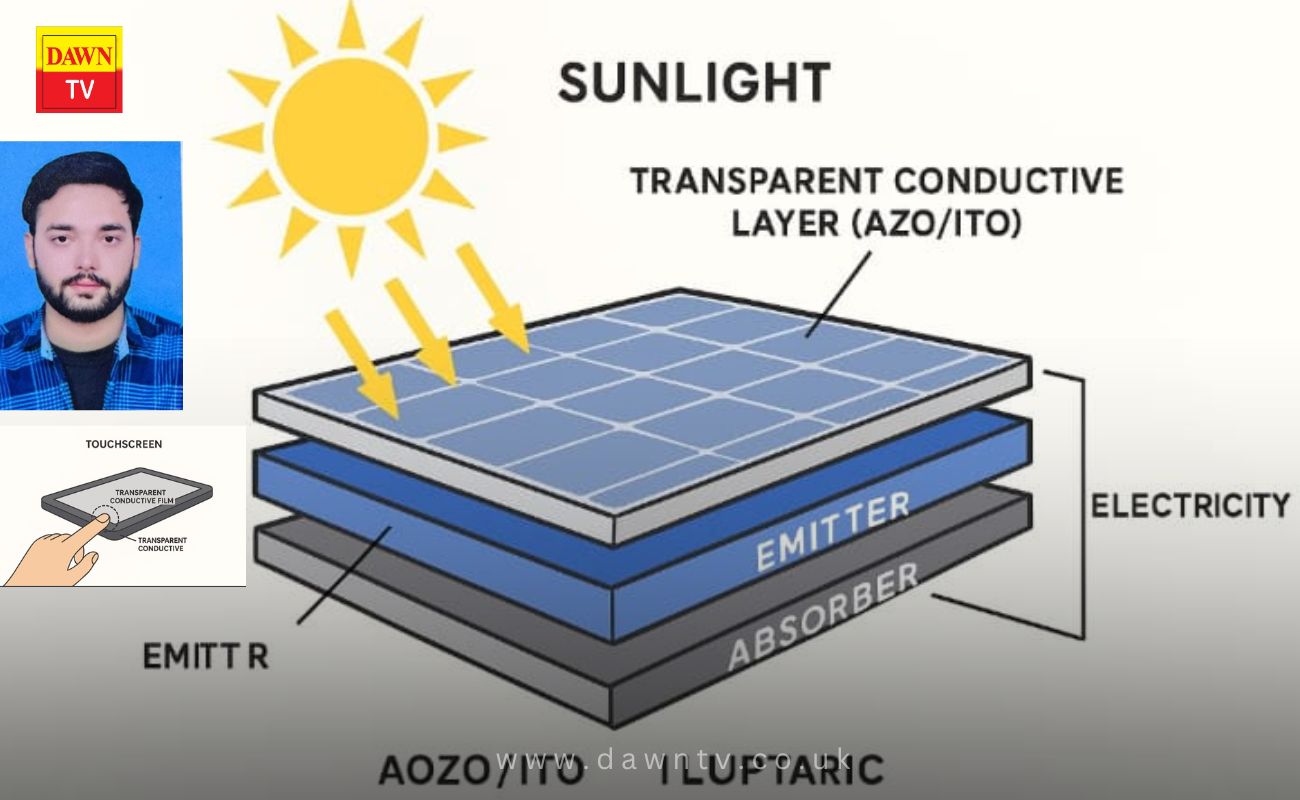
Did you ever ask yourself why your smartphone touchscreen responds so quickly to your touch or how certain new windows can power themselves up while allowing sunlight in? The secret is in an amazing branch of materials science: transparent conductive films. These materials are special in that they are both transparent and electrically conductive. This pairing may seem straightforward, but it’s a technological wonder that makes billions of devices that we use daily work. From touchscreen smartphones to solar panels, transparent conducting films are quietly revolutionizing the way we experience technology. One of the most prevalent materials in this category is Indium Tin Oxide (ITO). ITO has been utilized for decades because it is conductive to electricity while being nearly entirely transparent. Indium is rare and costly, though, which has spurred researchers to find replacements. Aluminum-doped Zinc Oxide (AZO) is one possibility. AZO is not only affordable, but it’s also eco-friendly and constructed from readily available components, so it’s a perfect fit for future technology. In the field of renewable energy, these films are revolutionaries. Solar panels require electrodes that can act as conductors of electricity without impeding the penetration of sunlight. Transparent conductive films such as AZO and ITO ideally meet this need. They provide a pathway through which sunlight penetrates the active layers of solar cells while also gathering the generated electricity. This technology has enhanced the efficiency of solar panels and has opened doors to new uses such as transparent solar windows—windows that power homes and offices while still being transparent. The technology powers contemporary electronics as well. Your smartphone, tablet, or smart watch would cease to operate without these films. Every touch you register is sensed by electric signals propagating through the transparent coating. Engineers precisely manipulate the thickness, surface roughness, and electrical characteristics of these films to maximize performance and longevity. Even minute gains in these specifications can make devices quicker, lighter, and more power-efficient. In studying AZO thin films deposited on ITO and glass, I investigated how minor modifications in the properties of films improve conductivity greatly without compromising transparency. Such work goes straight to the efficiency of forthcoming electronic and solar devices. But the future of transparent conductive films is greater than devices and energy. Researchers are investigating uses such as smart windows that can change transparency on their own, flexible electronics, and wearable technology. Consider garments that will charge your phone or your home walls that generate electricity without being opaque. Such technologies are not science fiction anymore—they are being enabled through research in next-generation thin films. Apart from technological advantages, these materials also play a role in sustainability. By substituting costly and rare materials such as indium with green alternatives such as AZO, scientists are facilitating cost reduction as well as environmental conservation. The blend of innovation, efficiency, and sustainability positions transparent conductive films as the foundation of contemporary science. In summary, the next time you swipe your phone or bask in sunlight pouring in through a solar window, recall the unseen layers that make everything possible. Transparent conductive films such as ITO and AZO are unassuming heroes of our technological era, energizing gadgets, propelling renewable energy, and creating a wiser, greener future.







Leave a Reply